Why Does the Black Sea Glow? The Mystery of Blue Waves Along Odesa’s Coast
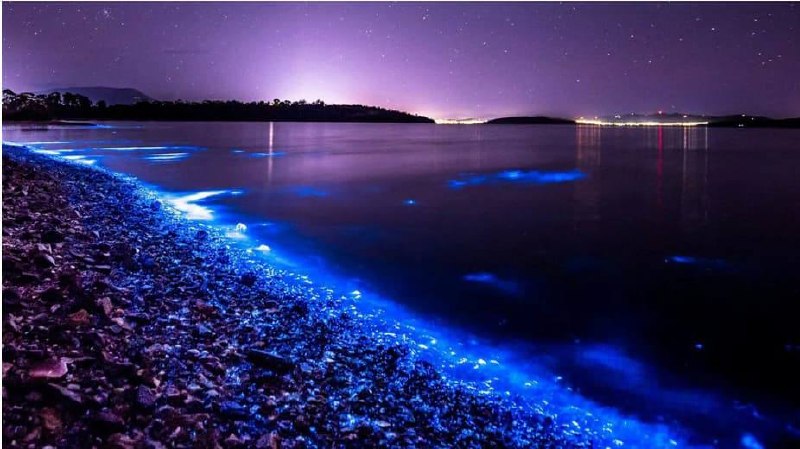
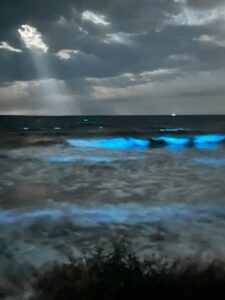
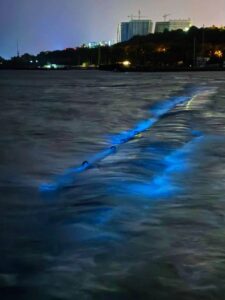
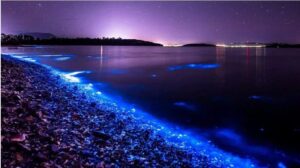
In the darkness, the Black Sea suddenly comes alive: waves begin to glow with blue light, shimmering lines appear along the shore, and the water looks like a star-filled sky. In recent days, this unusual phenomenon has also been observed along the coast of Odesa. But behind this magical spectacle lies a fascinating biological process known as bioluminescence. And it can tell us something important about marine life and the ecological health of the Black Sea.
What Makes the Sea Glow?
The glow is caused by tiny marine organisms that can produce their own light. One of the best-known bioluminescent organisms in the Black Sea is Noctiluca scintillans, commonly known as the sea sparkle.
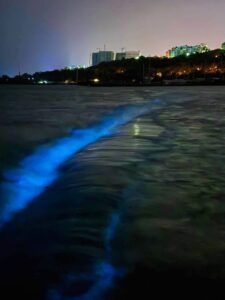
It is a single-celled organism belonging to a group called dinoflagellates. It feeds on other plankton and is usually less than a millimeter in size. However, when large numbers of these organisms gather in seawater, their light can become visible even from the shore.Inside their cells, a chemical reaction takes place involving a substance called luciferin and an enzyme known as luciferase. This reaction releases energy in the form of light, usually with a blue or blue-green glow. What makes this phenomenon particularly interesting is that the organisms produce light in response to physical movement. When a wave breaks against the shore, a fish swims past, or the water is disturbed, these microscopic creatures produce brief flashes of light. That is why the most spectacular glowing effects often appear on the crests of waves and along the coastline.
Why Does Plankton Produce Light?
Scientists believe that bioluminescence may serve as a defense mechanism. A sudden flash of light can frighten a predator trying to eat a microscopic organism. Another fascinating theory suggests that the light attracts larger predators to the animals feeding on the plankton. In this way, the tiny organism effectively activates an alarm signal. Similar mechanisms are found in many marine creatures. Jellyfish, squid, fish, and numerous deep-sea organisms use bioluminescence for protection, communication, hunting, or attracting prey.
Why Doesn’t the Black Sea Glow Every Night?
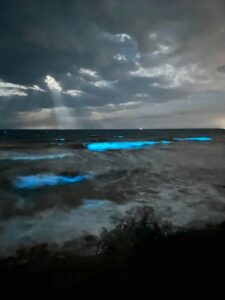
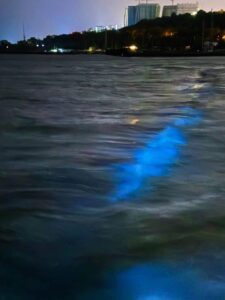
Noctiluca and other bioluminescent organisms may be present in seawater throughout the year, but their glow is not always visible. Several factors determine how bright the display becomes: the number of organisms, water movement, seasonal changes in the marine ecosystem, and the absence of strong artificial lighting.
The sea can glow in both summer and autumn. Plankton populations are influenced by water temperature, currents, nutrient availability, and the presence of other organisms they feed on. This explains why waves may glow bright blue along one section of the coastline while the water remains completely dark just a few kilometers away.
Does Glowing Water Mean the Sea Is Polluted?
Not necessarily.
Bioluminescence is a natural phenomenon that existed long before industrial development and modern water pollution.
However, the rapid growth of certain plankton species can sometimes indicate changes in the marine ecosystem.
For example, excessive amounts of nitrogen and phosphorus entering the water through wastewater, agricultural fertilizers, or river runoff can create favorable conditions for plankton growth.
This process is known as eutrophication.
Ukrainian researchers use Noctiluca as one of the biological indicators of the Black Sea’s ecological condition.
In particular, scientists study the relationship between its biomass and that of other zooplankton species in the Odesa and Danube regions.
Excessive plankton growth can affect marine food chains. When large amounts of organic matter decompose, oxygen is consumed, potentially creating dangerous conditions for fish and other marine organisms.
However, glowing blue water alone is not evidence of pollution or an environmental disaster.
Laboratory analysis is needed to determine the actual condition of the water.
What Can Glowing Water Tell Us About Climate Change?
The Black Sea is responding to climate change, and its microscopic inhabitants are no exception. Scientific studies show that temperature anomalies can affect the seasonal development of plankton, the balance between different species, and the intensity of bioluminescence. Changes in water temperature may shift the periods when certain organisms multiply most actively. These changes can influence the entire marine ecosystem because plankton plays an essential role in marine food webs. However, a single spectacular glowing event cannot be considered proof of global warming. Scientists need long-term observations to identify climate-related trends and understand their consequences.
Is Bioluminescence Dangerous to Humans?
Bioluminescence itself does not make seawater dangerous. Noctiluca scintillans is not known to produce toxins that are directly harmful to humans. However, large plankton blooms can sometimes be associated with a deterioration in water quality. Therefore, the color or brightness of the glow cannot tell us whether the water is safe for swimming. It is particularly important to follow official beach restrictions and consider the additional dangers associated with the ongoing war in Ukraine.
Читайте також на Медіа Кит: Дельфіни поруч із берегом: коли це природно, а коли — тривожний сигнал?
Share this content:





Post Comment