Living Side by Side: WWF-Ukraine Creates a Practical Guide to Safe Coexistence with Large Carnivores in the Carpathians
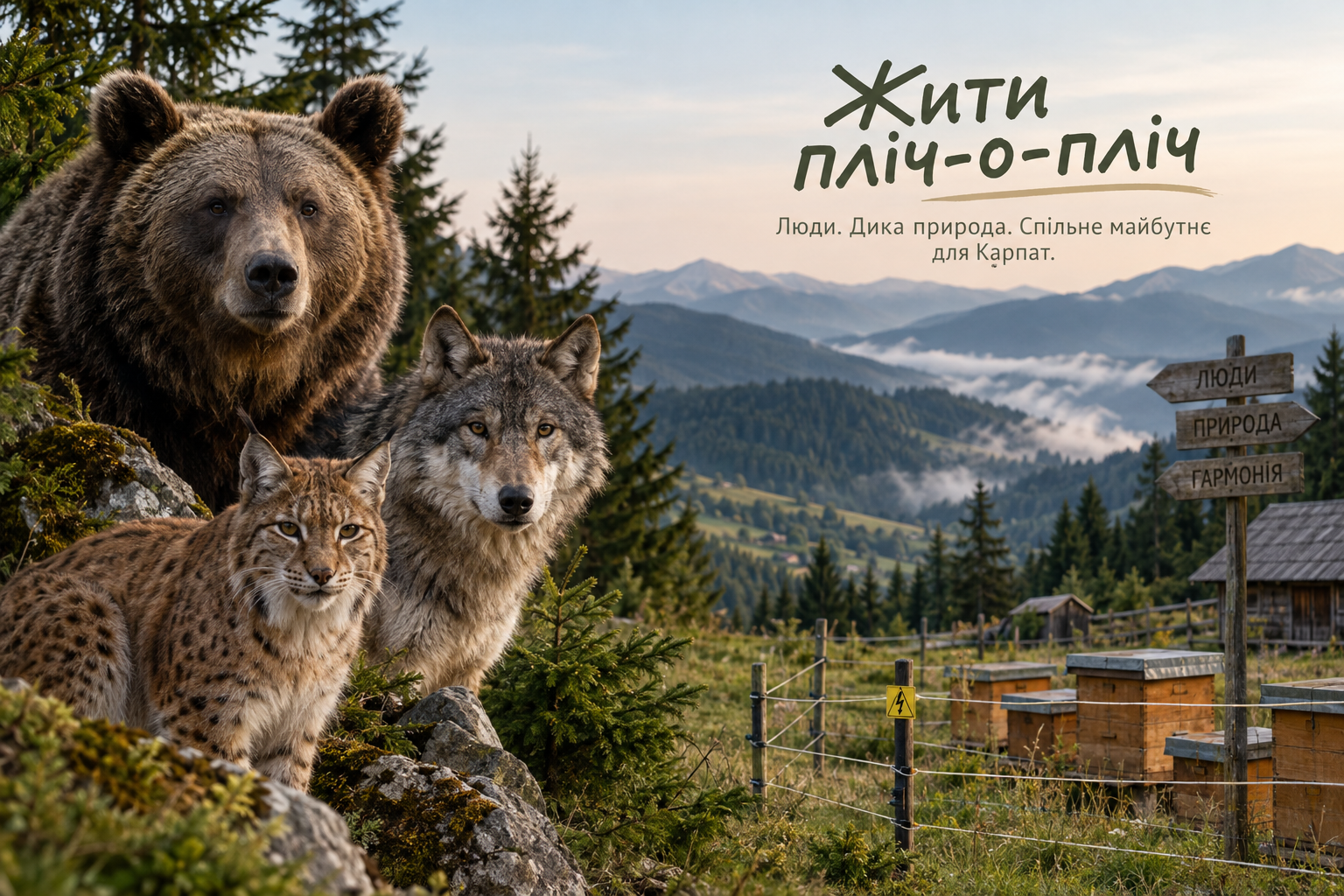
What should you do if a bear appears near your village? How can you protect your apiary or livestock from wild animals without harming them? WWF-Ukraine has prepared a practical online guide on the safe coexistence of humans and large carnivores in the Carpathians.
Bears, wolves, and lynxes are native inhabitants of the Carpathians and a vital part of local ecosystems. However, conflicts are inevitable where human and wildlife territories overlap: predators may approach villages, apiaries, and farms, while domestic animals can fall prey to them. The new online guide, *Living Side by Side: A Practical Guide to Coexistence with Large Carnivores*, explains how to minimize these risks without turning coexistence with wildlife into a constant struggle.
Why the Carpathians Need Large Carnivores
People traditionally view bears and wolves primarily as potential threats; however, large carnivores play crucial roles in natural ecosystems. They are part of a complex web of natural interconnections, influencing the populations and behavior of other animals and thereby helping to maintain the natural balance. In this guide, WWF explains which animals are classified as large carnivores in the Carpathians, the role they play in nature, and why their conservation is important not only for wildlife but also for local communities.
The authors go beyond simply discussing the need to protect bears, wolves, or lynx. A significant portion of the publication addresses a highly practical issue: how people can protect their farms, apiaries, or livestock while avoiding the need to kill wild animals.
How to avoid conflict with wild animals
Practical solutions proposed in the guide include the use of electric fences, livestock guarding dogs, protective structures for beehives, proper waste management, monitoring of wildlife movements, and early warning systems. Special emphasis is placed on the need to restore and preserve natural habitats; the less an animal’s territory is disturbed and the more accessible its natural food sources remain, the less reason it has to approach human settlements in search of food.
WWF identifies electric fences as one of the most effective ways to protect farms. They can be installed around apiaries, sheep pens, and other areas where livestock are kept. Such a fence delivers a brief, deterrent electric pulse that conditions the wild animal to avoid the area. This creates a safe boundary between the predator and the farm without the need to injure or kill the animal. As part of its work with local communities, WWF-Ukraine has already distributed over 45 electric fences in the Carpathian region to protect apiaries, livestock, and farms. This approach shifts the paradigm of responding to the presence of predators: instead of contending with an animal after a conflict has already occurred, communities gain the ability to prevent such situations from arising.
Why even ordinary trash bins matter
A lack of natural food sources is not the only reason wild animals venture close to human settlements. Accessible trash bins, food waste, and leftover scraps can also lure predators into populated areas. If a bear repeatedly finds easily accessible food near human dwellings, it may gradually lose its natural wariness and keep coming back.
That is why safe coexistence with large predators depends on more than just the animals’ behavior. People can prevent some conflicts by changing their own habits, waste management practices, and farm protection methods. This is particularly relevant for Carpathian communities, where settlements, pastures, hiking trails, and the natural habitats of large predators often lie in close proximity.
A guide useful for tourists, too
“Living Side by Side” was created not only for farmers and beekeepers. It is also a valuable resource for anyone traveling through the Carpathians who might find themselves in the territory of large wild animals. Understanding predator behavior helps avoid two extremes: panicking at the mere sight of a wild animal and, conversely, making dangerous attempts to get close to one for a photo or video.
The fundamental principle of such coexistence is that a wild animal must remain wild. One should not feed it, attempt to tame it, or close the distance to capture a perfect shot. Safe coexistence entails maintaining a boundary between human space and the animal’s natural habitat.
From Protecting Apiaries to Environmental Education
A dedicated section of the manual focuses on education. It compiles materials for teachers, facilitators, students, and youth groups, including basic facts about large carnivores, topics for discussion and debate, examples of role-playing games, and exercises that allow participants to examine real-life conflict situations.
The goal of these materials is not merely to explain to children why it is necessary to protect wolves, lynxes, or bears, but also to teach them to view the issue from multiple perspectives. Conservationists prioritize the preservation of populations and natural habitats; farmers focus on livestock safety and avoiding economic losses; local communities are concerned with human safety; and tourism regions seek to balance nature conservation with tourism development. Finding solutions that accommodate these diverse interests is becoming a crucial component of modern environmental education.
Learning to Coexist, Not Eliminate Predators
The core message of the WWF manual is that the presence of large carnivores near human settlements does not inevitably lead to conflict. Humans and wildlife can coexist if risks are anticipated in advance and communities have access to tools for protecting their livelihoods.
Electric fences, livestock guarding dogs, apiary protection measures, proper waste management, animal monitoring, and early warning systems cannot eliminate all risks entirely. However, they make it possible to shift from addressing consequences to preventing conflicts, while preserving space in the Carpathians for both humans and wildlife.
The full version of “Living Side-by-Side: A Practical Guide to Coexistence with Large Carnivores” can be viewed and downloaded via the link.
About the COOP4SAFE Project
The international COOP4SAFE project aims to conserve biodiversity and identify models for safe coexistence between humans and wildlife in the transboundary Carpathian region. The project fosters cooperation among Ukraine, Romania, and Slovakia and involves local communities in nature conservation initiatives.
The project brings together five key partners: WWF-Romania (Maramureș branch), the NGO “RakhivEcoTour” (in cooperation with WWF-Ukraine), the Maramureș Hunters and Anglers Association (Romania), AEVIS (Slovakia), and Verkhovyna National Nature Park. Such transboundary cooperation is particularly crucial regarding large carnivores, as these animals do not recognize national borders, and their natural habitats and migration routes often span multiple countries.
That is why conserving the Carpathians’ large carnivores is not merely a matter of protecting individual species. It is about preserving intact ecosystems while finding ways for people to safely live, work, and conduct their livelihoods alongside wildlife.
Material provided by WWF-Ukraine
Read also about Polonyna Runa
Share this content:





Post Comment